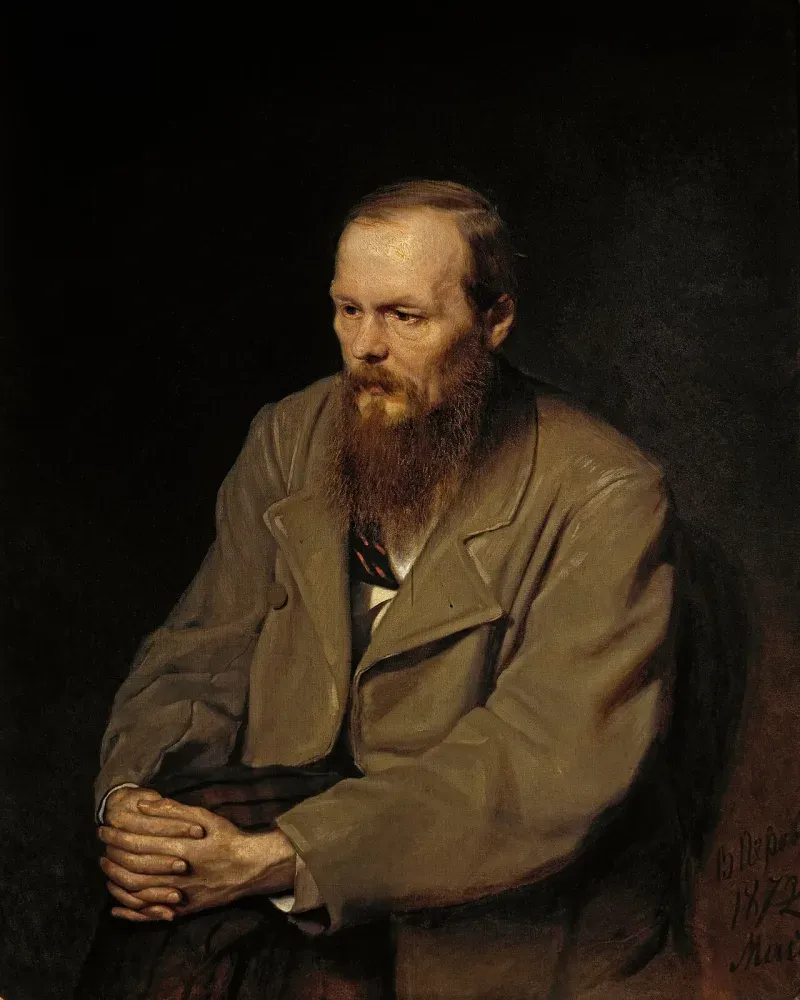
Biography
Fyodor Dostoevsky was born in Moscow on 11 November 1821, the son of a doctor at a hospital for the poor. He trained as a military engineer in St Petersburg, then left the service in 1844 to live by writing.
His first novel, Poor Folk, came out in January 1846. The critic Vissarion Belinsky praised it, and the 24-year-old author was suddenly famous. His next works, The Double and White Nights, got a cooler welcome.
In 1849 he was arrested as a member of the Petrashevsky circle, a group of young men who met to discuss banned ideas. The main charge was that he had read aloud a forbidden letter from Belinsky to Gogol. A court sentenced him to death.
On 22 December 1849 the prisoners were taken to Semyonovsky Square in St Petersburg, and the sentence was read. At the last minute an officer announced a pardon: hard labor instead of death. The tsar had signed it in advance, so the execution was staged on purpose.
He spent four years, 1850 to 1854, in a prison camp in Omsk, Siberia. Then he served as a private soldier in Semipalatinsk, now in Kazakhstan, and was allowed back to St Petersburg only in 1859. He told the story of the prison years in The House of the Dead.
In the 1860s he ran two magazines with his brother Mikhail. In 1864 his first wife, Maria, and his brother both died, and he took on the magazine’s debts. He also played roulette in German spa towns and lost again and again.
For money, he signed a harsh contract with the publisher Fyodor Stellovsky. If no new novel arrived by 1 November 1866, Stellovsky could print all his work for nine years without paying him. Dostoevsky dictated The Gambler to a stenographer, Anna Snitkina, in 26 days and met the deadline.
They married in February 1867, and she later ran his publishing business. He gave up gambling in 1871.
Between 1866 and 1880 he published five great novels: Crime and Punishment, The Idiot, Demons, The Adolescent, and The Brothers Karamazov. From 1873 he also wrote A Writer’s Diary, a journal by one author on politics, courts, faith, and the future of Russia.
On 8 June 1880 a Pushkin monument opened in Moscow. There Dostoevsky gave a speech on Russia’s gift for understanding other nations, and the hall answered with an ovation. He died in St Petersburg on 9 February 1881 and was buried at the Alexander Nevsky Monastery.
Why read him if you decide for others and answer for money and risk? Dostoevsky knew debt, loss, and a contract that could ruin him. His characters test an idea on their own lives and pay for the mistake.
Raskolnikov in Crime and Punishment decides that a great goal justifies a crime, and his own conscience breaks the plan. Ivan Karamazov asks what holds back a person who answers to no one. These are questions for any leader: where the right of the strong ends, what humiliation costs, and why money cannot buy respect. His books are translated into dozens of languages and taught at universities around the world.