
The four floors of AI in a company
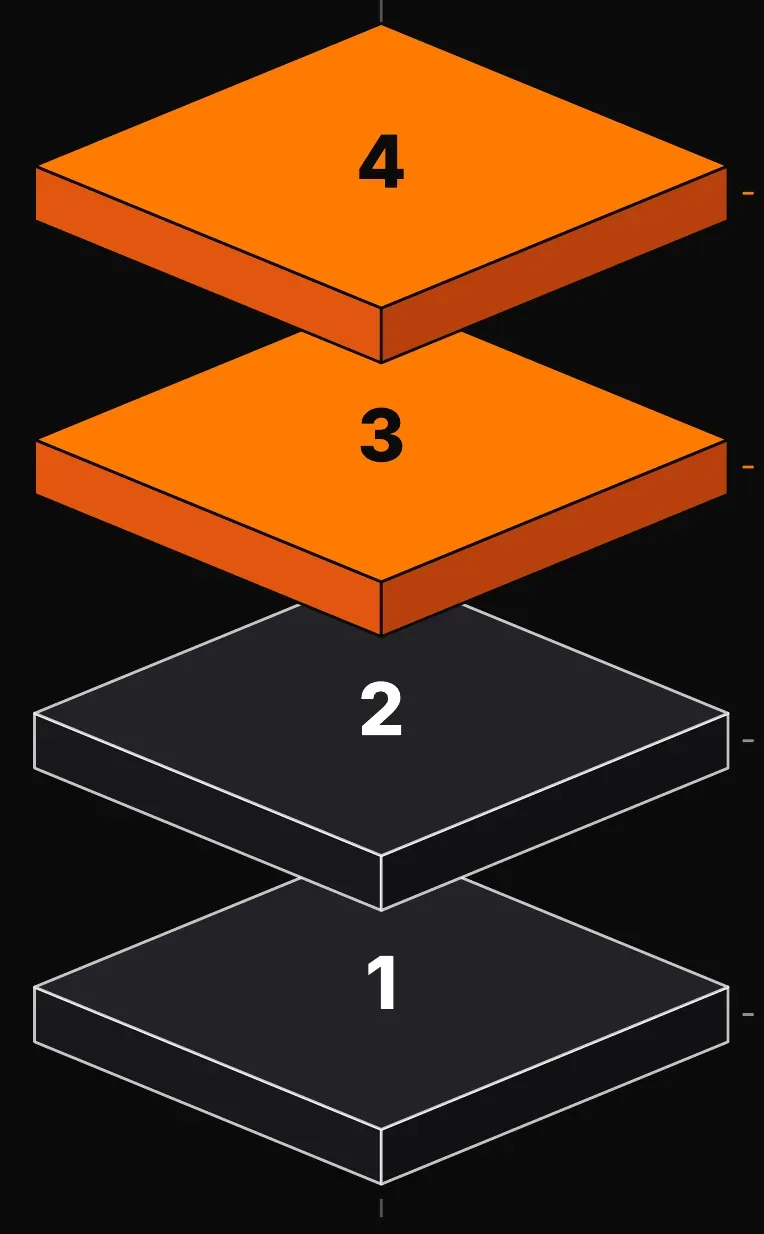
In simple words, AI in a company is not one program but four floors. The bottom floor collects data, the second connects the systems, the third analyzes and the fourth acts.
A comparison with a person helps. Sensors and accounting systems are the senses, the links between systems are the nervous system, analysis is the brain, and AI agents and robots are the hands.
There is one rule: an upper floor brings benefit only if the floors below it are built. A model without fresh figures forecasts from yesterday’s picture, and an agent without access to the accounts answers at random.
The diagram below shows the floors with examples of technologies. Next we look at each one: what stands on it and how to tell whether you have built it.
AI is not one program but four floors. The upper floors work only if the lower ones are built.
Floor 4 · hands
Action
AI does the work or prompts a person
- AI agents and generative AI
- Robots
For example: An agent prepares a report, a robot moves a pallet
Floor 3 · brain
Analysis
Finds causes and predicts
- Forecasts
- Machine vision
- Digital twin
For example: “The pump will fail in 5 days”, “this photo shows a defect”
Floor 2 · nervous system
System links
All data in one place, with no delay
- Integration with 1C, ERP, MES, CRM
- Servers and computing
For example: Sales, warehouse and shop floor see the same numbers
Floor 1 · senses
Data
What is happening in the company right now
- Sensors and cameras
- Accounting systems
- Documents
For example: Machine vibration, receipts, customer calls
Floor 1. Data
The first floor answers one question: what is happening in the company right now. It has three sources: sensors and cameras, accounting systems and documents.
The vibration of a machine, a cash receipt, a recording of a customer call, a delivery note in a warehouse: all of this is data. Without it, AI knows about your company only what open sources say, which is almost nothing useful.
A common problem on the first floor: important things live outside the systems. The price list sits in a manager’s spreadsheet, agreements with a customer sit in a messenger, and the return rules sit in a senior employee’s head. Move them into a system before the launch.
What to measure in your industry and how to collect it is covered on the page about data for AI.
Floor 2. Connected systems
The second floor gathers all data in one place with no delay. Sales, warehouse and workshop see the same figures, not three different spreadsheets.
Technically, this is the integration of accounting systems: 1C (accounting software popular in Russia), ERP (enterprise resource planning), MES (the system that runs production in the workshop) and CRM (the database of customers and deals). It also covers the servers and computing power on which the models run.
Example: a manager promises a customer a Friday shipment, but the warehouse sees the stock only after the evening export from 1C. If an AI agent takes the stock from such an export, it will promise goods that are already gone.
A manager usually does not notice this floor, because its result is not visible directly. But its absence shows at once: the figures in reports of different departments do not match.
Floor 3. Analysis
The third floor finds causes and predicts. Here AI first does what an ordinary program cannot: it notices patterns that a person has no time to review.
Forecasts say what will happen: “the pump will break in 5 days” or “demand will grow in three months”. Machine vision, a camera plus a model, finds defects in photos of products.
A digital twin is a copy of equipment or a process in a computer. You test a decision on it before you change anything in the workshop.
Analysis changes nothing by itself. A breakdown forecast is useful only if the foreman got it in time and could plan the repair. The page on predictive analytics shows how this works at a real plant.
Floor 4. Action
The fourth floor does the work or tells a person what to do. AI agents, generative AI and robots stand here.
An AI agent is a program that does a task step by step by itself: it collects figures from the systems, prepares a report, answers a customer or opens a deal. Generative AI writes texts, emails and summaries. A robot does physical work, such as moving a pallet across a warehouse.
This is the floor usually sold as “AI adoption”, because you can see it. But the agent prepares a report from the figures the second floor gave it, and the robot drives along a route the third floor calculated.
This explains the gap between a pilot and daily use. According to MIT NANDA for 2025, only 5% of custom AI tools reach everyday use, and 95% of organizations got no measurable return from generative AI.
Why the upper floors fail without the lower ones
The upper floors rest on the lower ones, as in any house. An agent without connected systems makes mistakes, a forecast without history guesses, and without sensors there is nothing to analyze.
BCG puts it this way: about 70% of the difficulties in AI projects come from people and processes, 20% from technology and only 10% from algorithms. The model is rarely the weak spot; the weak spot is usually at the bottom.
So start with the question of which floors you already have. If your records live in systems and those systems are connected, you can move on to analysis and action. If not, the first step is collecting and connecting data, and that step can be priced too.
A data readiness check helps you test the lower floors before you buy a ready-made solution: where the information lies, how complete it is and who has access.
In the AI roadmap each floor is a separate line with its cost and term. You see at once what to build first and what will pay back.