
Eight points where AI works in services
In services, AI works where the company meets the customer and the money: in retail, logistics, telecom, banking and internal services. Under all the points sits the same data: CRM, ERP, cash registers and apps, collected in one data center.
Three numbers set the scale: demand forecast accuracy above 70% in the Perekrestok pilot, 62% of customer requests at VTB resolved without an operator, and about 900 autonomous AI agents at one of Russia’s largest banks. The diagram below shows all eight points with sources.
These are open company data and market cases, not our projects. MIPT gave the estimate of $1.9 million a year for the X5 warehouse; the companies published the other figures themselves.
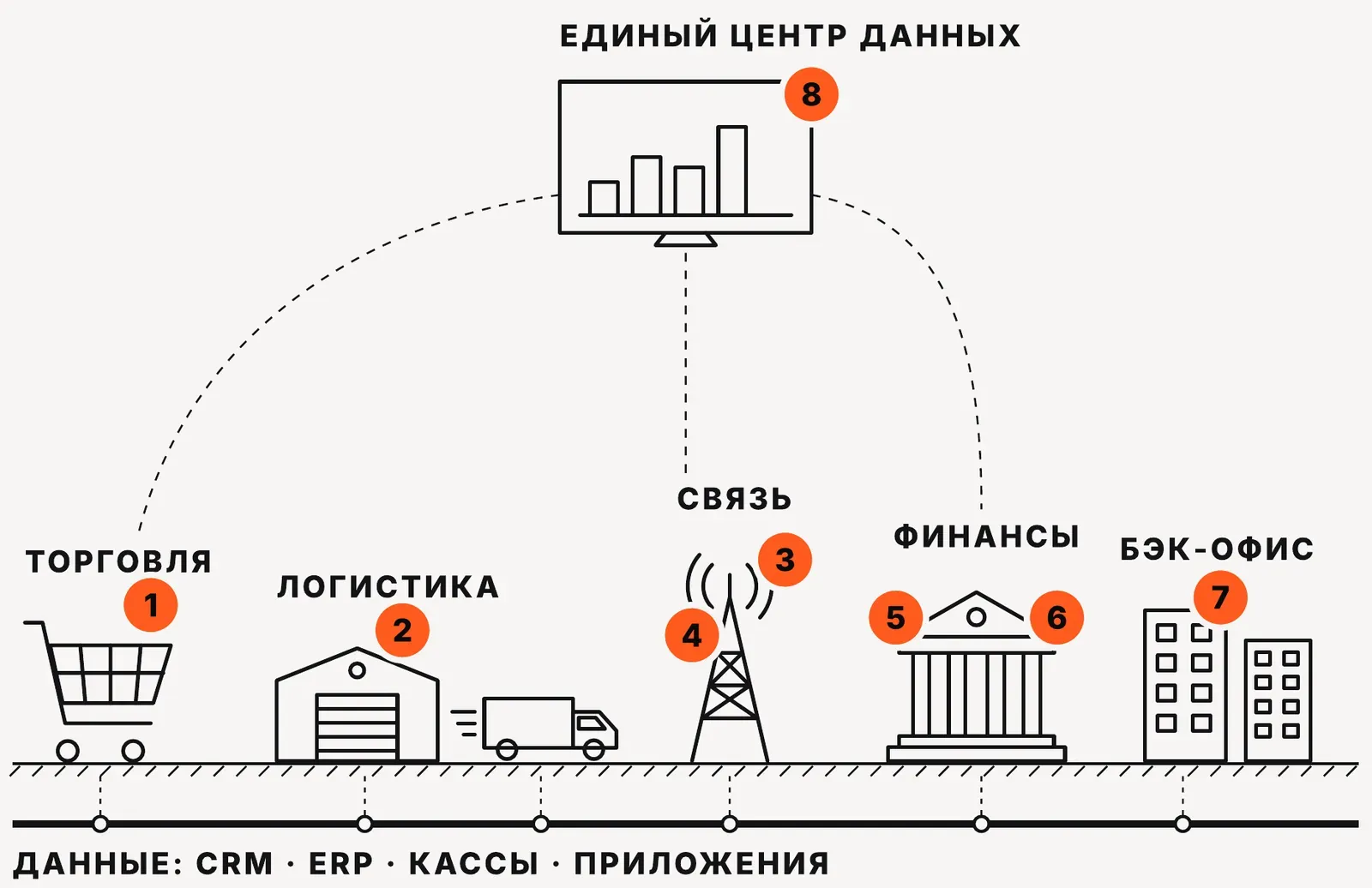
- 1Demand forecastover 70% accuracyX5, Perekrestok
- 2Warehouse and delivery$1.9 million a year per warehouseMIPT estimate
- 3AI support assistantwork of 700 agents, $40 millionKlarna
- 4Contact center62% of requests with no agentVTB
- 5Debt collection83% of calls, $54 milliona large Russian bank
- 6AI across the bank$5.7 billion in 2025a large Russian bank
- 7AI agentsabout 900 agentsa large Russian bank
- 8Reply to a customer11 minutes → 2 minutesKlarna
Retail.ru, 08.06.2020 · Almanac “AI in industry”, MIPT Institute for AI, 2026 · Klarna, 27.02.2024 · ITSpeaker, April 2026 · CNews, 18.09.2025 · TASS via the Ministry of Transport, 30.07.2026
AI in retail: demand forecasting and the warehouse
AI in retail forecasts demand and runs the warehouse, so that the right product is on the shelf and extra stock does not sit in storage. In a 2020 pilot, the Perekrestok chain (X5) reached demand forecast accuracy above 70%.
The forecast is made for each product and store: sales history, season, promotions and holidays. An accurate forecast cuts lost sales from empty shelves and write-offs from extra stock.
In the warehouse, AI plans the work of robots and the routes for picking orders. The MIPT almanac estimates the effect of autonomous robots at one X5 warehouse at $1.9 million a year.
AI in retail links both tasks: the forecast says how much product is needed, and the warehouse decides how to deliver it faster. The page on demand forecasting explains how the forecast is built and what data it needs.
AI in finance and banking
AI in a bank works on debt collection, customer service and internal operations, and the effect there runs to tens of millions of dollars. At one of Russia’s largest banks, a robot makes 83% of outbound calls on overdue debts, and the effect of AI in collection is about $54 million for 2025, according to CNews in September 2025.
According to a report of the bank’s corporate university, published by TASS in July 2026, the financial effect of AI at this bank for 2025 is more than $5.7 billion. About 900 autonomous AI agents work at the bank, and generative AI gave more than $600 million of the total effect.
For a smaller company, the logic is the same: an AI agent takes over repeated operations, and an employee handles the exceptions. The rollout formats and prices are on the services page.
Customer support and the contact center
In support, AI answers standard questions around the clock and passes only hard cases to an operator. At VTB, robots resolve more than 62% of customer requests without an operator, according to April 2026 data.
In February 2024, Klarna reported that its AI assistant held 2.3 million conversations in its first month, the work of 700 agents. The time to resolve an issue fell from 11 to 2 minutes, and the company expected a profit gain of about 40 million US dollars for 2024.
For a contact center, this means a shorter queue and lower support costs without hiring new operators. The effect is counted by three numbers: requests per month, the share of standard questions and the cost of an operator’s minute.
What changes in money
In services, AI pays back through customers and changes four lines: revenue, support costs, cash turnover and hiring. Revenue grows when the right product is on the shelf and fewer sales are lost.
Support costs fall because AI answers standard questions around the clock. Turnover speeds up when debts and payments come back sooner. The result for the owner: more customers with the same staff.
In services, AI pays back through customers: faster replies, a better product range, more sales with the same headcount.
What improves in the process
- 01More accurate demand forecastover 70% accuracy X5
- 02Reply to a customer in 2 minutesinstead of 11 minutes Klarna
- 03Contact center with no queue62% of requests with no agent VTB
- 04Debt collectionAI makes 83% of calls, $54 million a large Russian bank
- 05Generative AI at the bankover $600 million a large Russian bank
What changes in money terms
Higher revenue
the right product on the shelf, fewer lost sales
Lower support costs
AI answers routine questions around the clock
Faster cash turnover
debts and payments come back sooner
Growth without hiring
more customers with the same staff
Result
More customers with the same headcount
$5.7 billion
AI effect in 2025, a large Russian bank
Retail.ru, 08.06.2020 · Klarna, 27.02.2024 · ITSpeaker, April 2026 · CNews, 18.09.2025 · TASS via the Ministry of Transport, 30.07.2026
Where a service company should start
A small company does not need a bank-level data center. Start with one process that has many repeated requests or operations: replies to customers, processing of requests or reminders about debts.
Count how many hours a month it takes and what an employee’s hour costs. If the sum is noticeable, one AI agent on this process is a good first step. If there are several linked processes, you need an AI solution map with the calculated effect and the rollout order.
A free 30-minute review: we will name the processes where similar companies have already seen an effect and say what data is missing for the calculation.