
Seven use cases of AI in extraction
The use cases of AI in extraction sit where raw material is found, extracted and moved: in exploration, at wells, open pits and fields. All of them rely on the same data: sensors on equipment, satellite images and machine telemetry.
Three numbers set the scale: +0.5% daily output at Samotlor, +20% productivity of SUEK’s open-pit haul trucks, and $5.5 million a year from autonomous drilling. The MIPT almanac puts the value of AI-based gold exploration at $1.1 million a year.
The diagram below shows seven points and the data for each. These are market cases, not our projects: we use them as a guide for a calculation on your numbers.
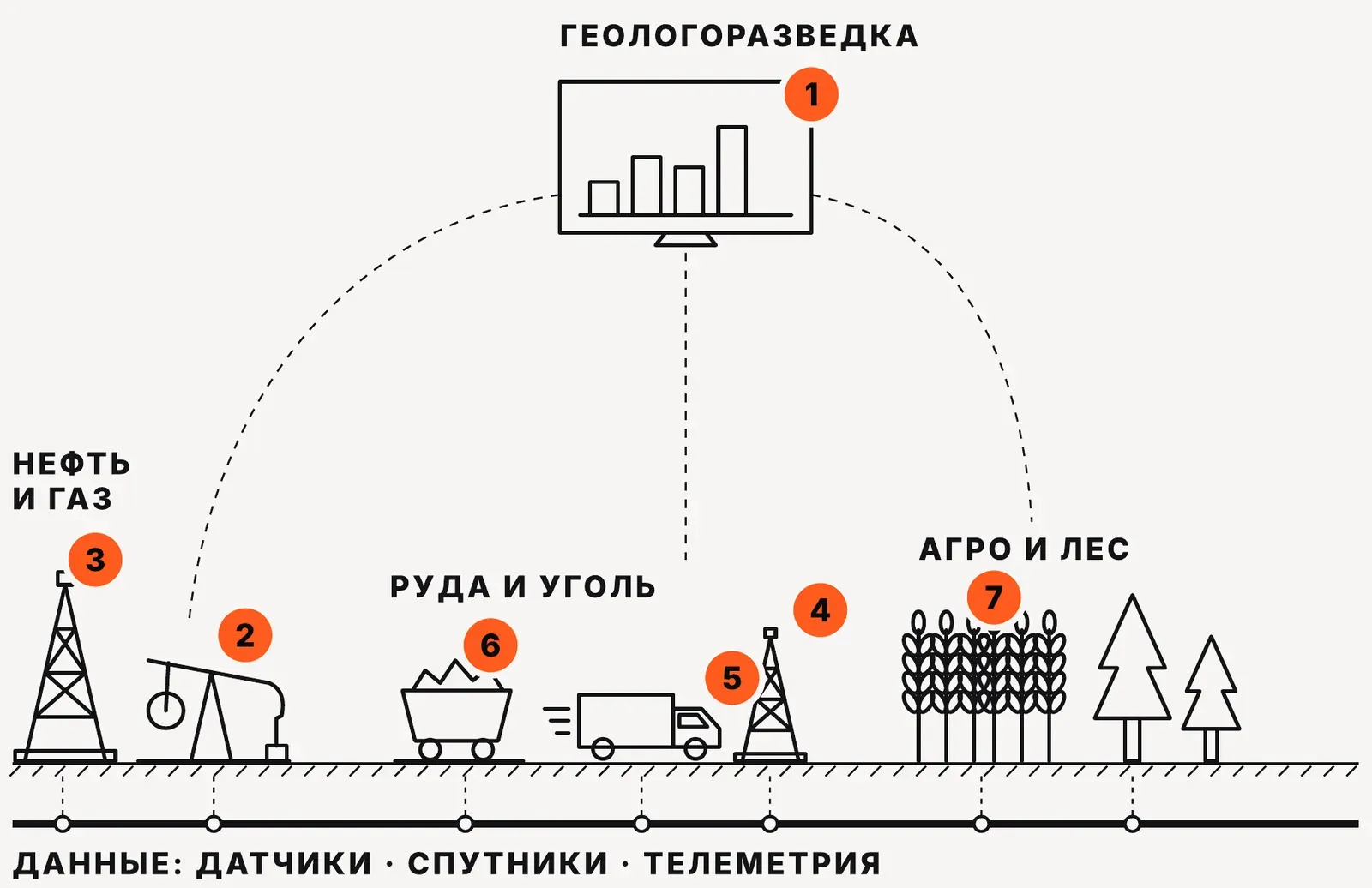
- 1Finding deposits$1.1 million a yeargold, MIPT almanac
- 2Oil production+0.5% daily outputRosneft, Samotlor
- 3Flares and leaks$1.8 million a yearoil and gas, MIPT almanac
- 4Autonomous drilling+2% output, $5.5 million a yearNornickel, MIPT almanac
- 5Quarry trucks+20% productivitySUEK, MIPT almanac
- 6Ore analysis98% match with manual measurementsSSGPO, ERG
- 7Precision farmingfertilizer and machines by field mapindustry practice
Almanac “AI in industry”, MIPT Institute for AI, 2026 · ComNews, 24.08.2023 · Redmadrobot, SSGPO case
Oil and gas: a field twin and flare control
In oil and gas, AI gives its effect through a digital twin of the field and flare control. Samotlorneftegaz (Rosneft) built digital twins of ten sections: daily output grew by 0.5%, an effect of $2.6 million, according to ComNews of 24 August 2023.
The twin gathers data from wells, pumps and the reservoir into one model and shows where the mode can be raised without risk to equipment. Half a percent of daily output at a large field is worth millions of dollars, because the yield of already drilled wells grows.
The second common use of AI in oil and gas is flares: a model watches burning and leaks through video and sensors and warns of a deviation before an accident. The MIPT almanac puts the value of flare monitoring at $1.8 million a year.
How the twin works and what data it needs is covered on the page on the digital twin.
Ore and coal: autonomous machines and ore analysis
In mining, AI drives machines without a driver and grades ore right on the conveyor. SUEK’s autonomous open-pit haul trucks are 20% more productive and bring $1.7 million a year.
Nornickel’s autonomous drilling rigs gave +2% output and $5.5 million a year at one site. Machines with nobody in the cab work in dangerous zones, and fewer people are there.
Machine vision at SSGPO (ERG) grades ore on the conveyor, and its grading matches manual measurements in 98% of cases. The plant knows the quality of raw material before processing, not after a lab test.
AI in agriculture: precision farming
AI in agriculture is needed above all for precision farming: a field is split into plots, and each plot gets its own rate of seed, fertilizer and water. Instead of one rate for the whole field, the machine applies as much as the plot needs.
The model needs three kinds of data: images from satellites and drones, data from soil and weather sensors, and the yield history of each plot over several seasons. Without the yield history, the model cannot tell a weak plot from a bad year.
Open sources have no verified estimate of the effect in money for Russian farms, so we give no figure. We calculate the effect for a specific farm on its data on costs and yield.
What changes in money
In extraction, AI changes four lines: cost per ton, output volume, number of accidents and the safety of people. Cost falls thanks to lower spending on fuel, downtime and empty wells, and volume grows because the same assets give more raw material.
There are fewer accidents when a model notices an early signal before a failure or a leak. The result for the owner: more output from the same wells, pits and fields with no new assets. The market benchmark: $5.5 million a year at one site.
In extraction, AI pays back in tonnes and barrels: more raw material from the same wells, quarries and fields.
What improves in the process
- 01More oil from the same wells+0.5% daily output, $2.6 million Rosneft
- 02Autonomous drilling+2% output Nornickel
- 03Quarry machines with no driver+20% productivity, $1.7 million a year SUEK
- 04Fewer flare accidents$1.8 million a year MIPT almanac
- 05Accurate ore grading98% match with manual measurements SSGPO
What changes in money terms
Lower cost per tonne
less fuel, downtime and dry wells
Higher output
the same assets give more raw material
Fewer accidents
early signals before a failure or a leak
Safer for people
machines work in danger zones with no driver
Result
More output from the same assets
$5.5 million
a year at one site: autonomous drilling, Nornickel
Almanac “AI in industry”, MIPT Institute for AI, 2026 · ComNews, 24.08.2023 · Redmadrobot, SSGPO case
Where an extraction company should start
Start with a section where losses are already counted: drilling rig downtime, empty truck runs, emergency stops. The more precisely you know the cost of an hour of downtime, the faster you can calculate the effect of a solution.
Then check the data: are there sensors on equipment, machine telemetry, a history of several years? If data is lacking, start with collecting it, not with a model; what to collect and how is described on the page on data for AI.
For equipment failures, predictive analytics fits; for decisions across the company, the AI solutions map: processes, the effect in money and the rollout order in 7 weeks. A free 30-minute review: we name two or three processes to start with.