
Where AI brings an effect: from extraction to market
The almanac’s cases fit neatly along the value chain. Each link has a solution with an effect in money, and these are not lab experiments but the lines, open pits and warehouses of working companies.
In extraction, Nornickel runs autonomous drilling rigs (+2% output, $5.5 million a year), and Rosneft has a digital twin of the Samotlor field (+0.5% daily output). SUEK runs autonomous mining dump trucks (+20% productivity). In logistics, MIPT values supply chain optimization for rolled steel at $33 million a year, and robots in one X5 warehouse at $1.9 million a year.
In production, AI picks the pelletizing mode at Severstal (+11.4% productivity), analyzes ore on an NLMK conveyor ($1.4 million a year) and predicts breakdowns at the Cherepovets steel mill. At the market level, Severstal linked production load with the sales forecast: EBITDA up to 7% higher, an effect of $120 million.
These are market cases, not our projects. We use them as a benchmark: if you have a similar process, your map will hold a calculation on your numbers.
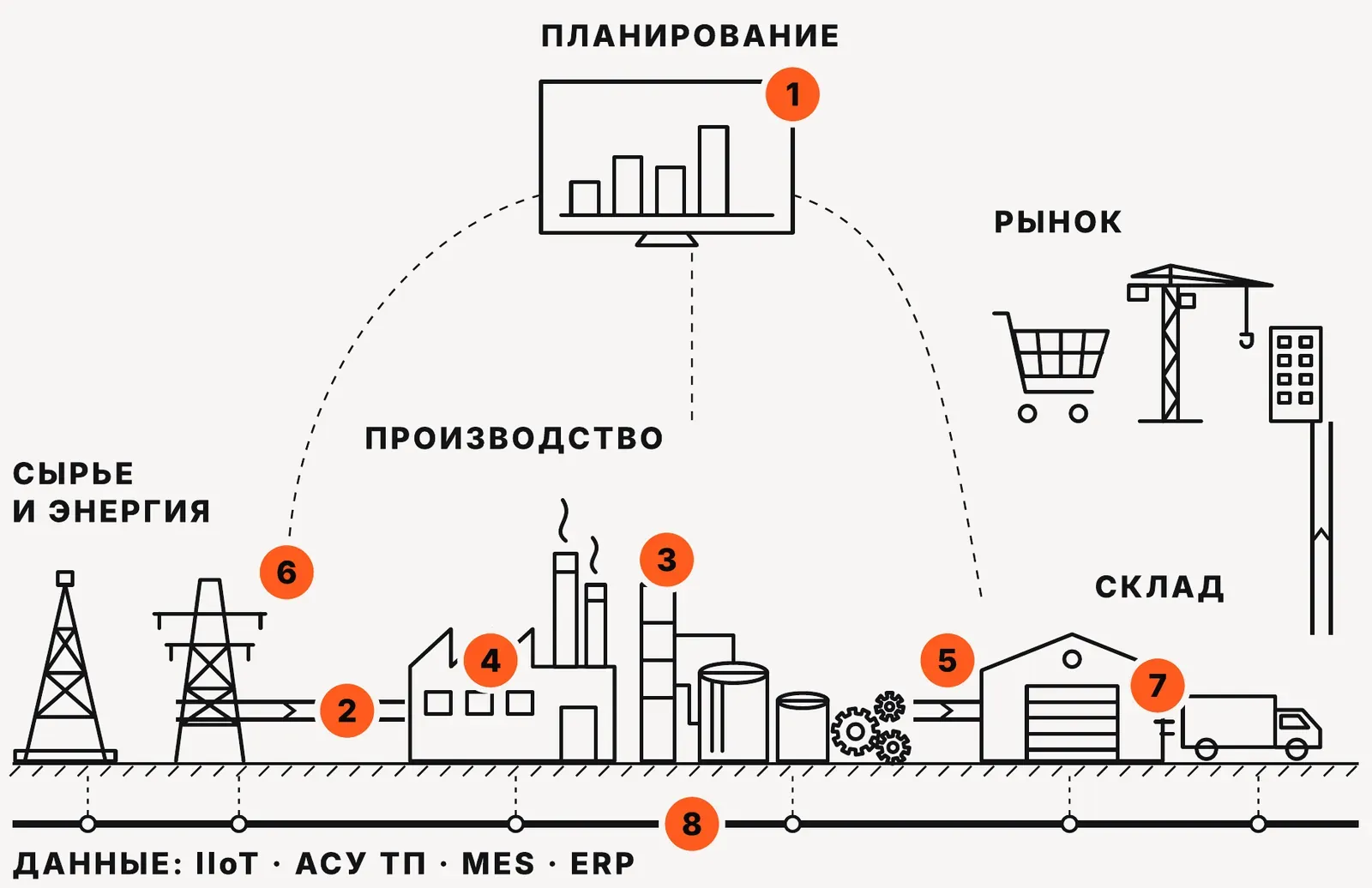
- 1Load planningEBITDA up to +7%Severstal
- 2Purchasing and supply20% lower warehouse costsMIPT estimate
- 3Process control+11.4% outputSeverstal
- 4Predictive maintenance7 hours of downtime = $780,000Cherepovets mill
- 5Quality control$290,000 a yearsteelmaking
- 6Energy$1.1 million a yearplant energy savings
- 7Warehouse and logistics$1.9 million a yearwarehouse robots, MIPT estimate
- 8Documents and knowledge$520,000 a yearsearch in plant documents
Almanac “AI in industry”, MIPT Institute for AI, 2026 · ComNews, 19.04.2024
The effect of one solution in money
On one scale, the spread is wide: from $140,000 a year for waste sorting to $5.5 million for autonomous drilling. The median across 12 cases with an annual estimate is $1.7 million, and the total effect is more than $52 million a year.
The largest sums come from solutions that change the work of the whole company: load planning and supply chains. A point solution in one unit brings tens of millions, but it launches faster and pays back sooner.
Some figures in the almanac are MIPT estimates from public data. The Rosneft effect has no year attached, and the Cherepovets effect is calculated for 7 hours of reduced downtime. So a budget decision needs a calculation on your data, not someone else’s number.
- Drilling rigs · Nornickel5.5
- Process control · Severstal3.1
- Oil production · Rosneft>2.6
- Specification checks · construction1.9
- Warehouse robots · X51.9
- Flare monitoring · oil and gas1.8
- Mining dump trucks · SUEK1.7
- Ore analysis · NLMK1.4
- Energy optimization · plant1.1
- Deposit exploration · gold mining1.1
- Failure prediction · Severstal0.78
- Search in documentation · plant0.52
- Quality control · steel0.29
- Waste sorting · recycling0.14
Off the scale: company-wide solutions
$120 million
Up to 7% more EBITDA: production load planning
Severstal IPS
$33 million
A year: supply chains, 20% lower warehouse costs
MIPT estimate
The Rosneft effect is a total with no year attached; the Cherepovets Steel Mill figure is for 7 hours less downtime. Almanac “AI in Industry”, AI Institute of MIPT (Moscow Institute of Physics and Technology), 2026
Eight layers: why one model is not enough
The almanac describes an AI technology stack in production with eight layers. Five of them are AI: computing optimization, predictive analytics, machine vision, robots and generative AI. Three layers hold them up: sensors and IIoT, digital twins, and integration with process control systems (APCS), MES and ERP.
A top-layer solution will not pay back without the lower ones. A model that predicts a breakdown is useless without vibration sensors on the equipment and without a link to the system where the foreman plans repairs.
So in AI due diligence, a full check of a company before adoption, we look at all eight layers, not only the model. If sensors or data are missing, the map shows this as a separate step with its own cost and timeline.
- Layer 8Generative AIAI
- Layer 7RobotsAI
- Layer 6Machine visionAI
- Layer 5Predictive analyticsAI
- Layer 4Integration with process control, MES and ERPBase
- Layer 3Compute optimizationAI
- Layer 2Digital twinsBase
- Layer 1IIoT, sensors and camerasBase
A top-layer solution does not pay off without the layers below, so the roadmap checks all eight. Almanac “AI in Industry”, AI Institute of MIPT (Moscow Institute of Physics and Technology), 2026
Breakdown prediction: the Cherepovets steel mill case
At Severstal’s Cherepovets steel mill, a model watches the conveyors of hot-rolled coils. It finds a deviation in equipment operation, identifies its source and predicts when the parameters will go beyond the limits. Then it warns the staff in advance.
A window for repair opens between the anomaly and the failure. The stop is planned instead of waiting for an accident: downtime fell by 7 hours, which brought $780,000.
For your production, the calculation is the same. What an hour of line downtime costs, how many hours a year go to emergency stops, and what share of them the model can prevent.
$780,000
from 7 hours less downtime
- 01Finds deviations in how equipment runs
- 02Locates the source of the anomaly
- 03Predicts when readings will leave safe limits
- 04Warns the staff in advance
Almanac “AI in Industry”, AI Institute of MIPT (Moscow Institute of Physics and Technology), 2026
How a case becomes a line in the map
An AI solution map consists of lines: process, problem, solution, technologies and effect. An example line from the Severstal case: pelletizing, with particle size control on the line. The process depends on hundreds of parameters, and late detection of deviations lowers quality and productivity.
Solution: a model trained on historical and streaming data finds the causes of deviations and suggests the optimal mode. Technologies: IIoT, deep neural networks and scenario modeling. Effect in the case: $3.1 million a year and +11.4% productivity.
On your data, we add to the line the cost of adoption and ownership, the payback period, NPV and IRR, the contractor, the owner and the place in the roadmap. Then the line goes onto a priority matrix that sets effect against complexity. What gives a lot and is simple to do goes first.
Our map example for a company with several departments shows what the whole map looks like.
- Process
- Pelletizing: particle size control on the line
- Problem
- The process depends on hundreds of parameters; late detection of deviations cuts quality and output
- Solution
- A model on historical and live data finds the causes of deviations and suggests the right operating mode
- Technology
- IIoT, deep neural networks, scenario modeling
- Effect
$3.1 million a year
+11.4% productivity
Severstal, pelletizing line
What we add from your data
- Cost of rollout and ownership
- Payback, NPV and IRR
- Contractor
- Owner
- Place in the roadmap
Priority
↑ Effect
- Do firstPelletizing
- Plan
- Quick wins
- Postpone
Complexity →
Example. We set the place on the matrix during the effect calculation. Almanac “AI in Industry”, AI Institute of MIPT (Moscow Institute of Physics and Technology), 2026
Where a manufacturing company should start
Start with losses, not with technology. Take three numbers: what an hour of downtime costs, how many defects go to rework and how many hours engineers spend searching documentation. Where the sum is largest, you have the first candidate for the map.
Then check the base: are there sensors in this unit, where is the data stored and who owns the process? By BCG’s estimate, about 70% of adoption difficulties come from people and processes, 20% from technology and only 10% from algorithms.
If your production is small and you first need an agent for requests and quotes, see the page on AI for a manufacturing company. If you plan to adopt AI at a plant with several shops, start with a review. In a free 30 minutes, we will name two or three processes where similar companies already got an effect and tell you what data is missing for the calculation.
The business effect of AI is counted in money: on one process or across the whole company.
What improves in the process
- 01Fewer breakdowns, longer equipment life7 hours of downtime = $780,000 Severstal, Cherepovets mill
- 02Lower energy use$1.1 million a year plant
- 03Higher line productivity+11.4% output Severstal
- 04More accurate planningEBITDA up to +7% Severstal
- 05Faster work with documents$520,000 a year plant
What changes in money terms
Lower unit cost
less raw material, energy and hours per unit
Higher quality
fewer defects, losses and claims
Lower operating costs
repairs, maintenance, logistics
Less dependence on staff
the model takes the routine, people decide
Result
Higher operating profit
$120 million
EBITDA growth from one planning project, Severstal
Almanac “AI in industry”, MIPT Institute for AI, 2026 · ComNews, 19.04.2024