
How AI builds a forecast
AI in forecasting relies on the company’s own history. The model takes facts from past periods, finds patterns in them and extends the line forward.
A sales forecast usually uses daily sales, prices and promotions, season, holidays and stock. The model weighs all of this at once, while a person keeps two or three factors in mind.
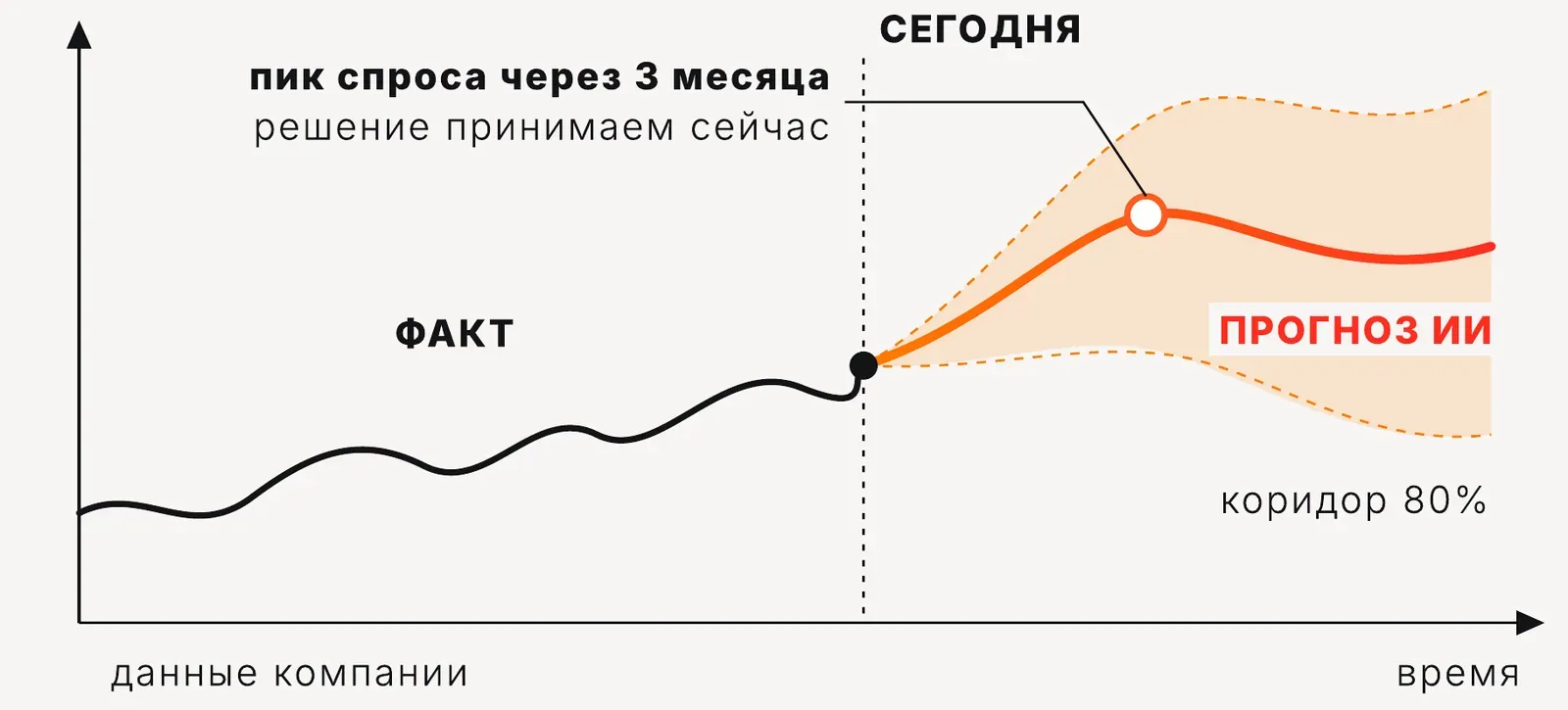
A good forecast gives not one number but a range: the limits within which the value will fall. If the range is wide, purchasing is more careful; if it is narrow, planning can be bolder.
The main benefit is time. The model sees a demand peak 3 months ahead, and you make the decision on purchasing, hiring or repair now, while it is cheaper. The chart below shows how a forecast continues the actual data.
>70%
demand forecast accuracy
X5, Perekrestok
up to +7%
EBITDA from planning
Severstal
$780,000
saved by breakdown prediction over 7 hours of downtime
Severstal, Cherepovets mill
$120 million
effect of load planning
MIPT almanac
Retail.ru, 08.06.2020 · ComNews, 19.04.2024 · Almanac “AI in industry”, MIPT Institute for AI, 2026
Demand forecasting in retail
In retail, a forecast solves two problems at once: an empty shelf and write-offs. Too little stock and the store loses a sale; too much and it loses on discounts and disposal.
X5 launched a demand forecasting system at Perekrestok in 2020. In the pilot, forecast accuracy exceeded 70% (Retail.ru, June 2020).
Always ask the contractor how the accuracy number is calculated: by which measure, on which horizon and for which products. A forecast for tomorrow for milk and a forecast for a quarter for a new item cannot be compared.
Other solutions for stores, warehouses and banks are collected on our page about AI in retail and finance.
Forecasting breakdowns and repair costs
A breakdown forecast follows the same logic, but instead of sales the model looks at vibration, temperature and other equipment readings. It notices a deviation and estimates how much time is left before a failure.
At Severstal’s Cherepovets steel mill, the model prevented 7 hours of downtime, worth $780,000 by the estimate of the MIPT Institute of AI almanac 2026. A repair stop can be planned instead of waiting for an accident.
Repair costs go down thanks to the same window: the part is ordered in advance, and the crew comes out during a regular shift. We found no general figures for cost savings with a verified source. So we calculate on your data: the cost of an hour of downtime, the number of accidents per year and the difference between planned and emergency repair.
Our page on predictive analytics explains what data such a forecast needs and how it pays back.
Planning production load
Load planning links the sales forecast with the work of the plants. The model picks what to produce, where and when, so orders are met at lower cost.
Severstal presented an integrated planning system in 2024 and expected planned EBITDA to grow by 5–7% (ComNews, April 2024). The MIPT almanac estimates the effect at $120 million, with EBITDA up to 7% higher.
Next to it is supply chain optimization for rolled steel: 20% lower warehouse costs, or $33 million a year by the MIPT estimate. Both are market cases, not our projects, and both change the work of the whole company, not of one unit.
Such solutions bring large sums, but they need connected systems: sales, warehouse and production must see the same numbers. Other examples are collected on our page about AI in manufacturing.
What will change by 2030
Forecasts will become a normal part of management, and decisions will rely on data more often than on one person’s experience. We see three shifts, and each already has examples today.
1. More operations will run automatically. At VTB, robots resolve more than 62% of customer requests without an operator (April 2026), and at a large Russian bank a robot makes 83% of outgoing calls about overdue debts.
2. Robots will work next to people in the same shift. By the MIPT estimate, autonomous robots in one X5 warehouse bring $1.9 million a year.
3. Systems will propose decisions themselves and make some without a person. A large Russian bank already runs about 900 autonomous AI agents (report of its corporate university, July 2026).
Companies that collect their history now will have something to build these solutions on. The rest will have to start from the ground floor when competitors are already working with forecasts.
Where to start
Choose one decision that you make in advance and where an error costs money: purchasing, repair, shift schedules. Calculate what errors cost you last year.
Check your history: do you have daily sales, failures with dates and load by shift, and are they in a system rather than in employees’ spreadsheets? Before launch, test the forecast on a past period: the model predicts a month you already know, and you compare the result with the facts.
In an AI solution map, such a forecast is a line with its effect, cost and payback period. In a free 30-minute review, we will tell you which forecast will pay off first and what data it is missing.